1. Find gross profit per sale
Multiply average sale value by gross margin. A ₹20,000 sale at 40% margin leaves ₹8,000 before marketing and overhead.
PPC services / India
Paid media built around qualified leads, sales and accountable spend.
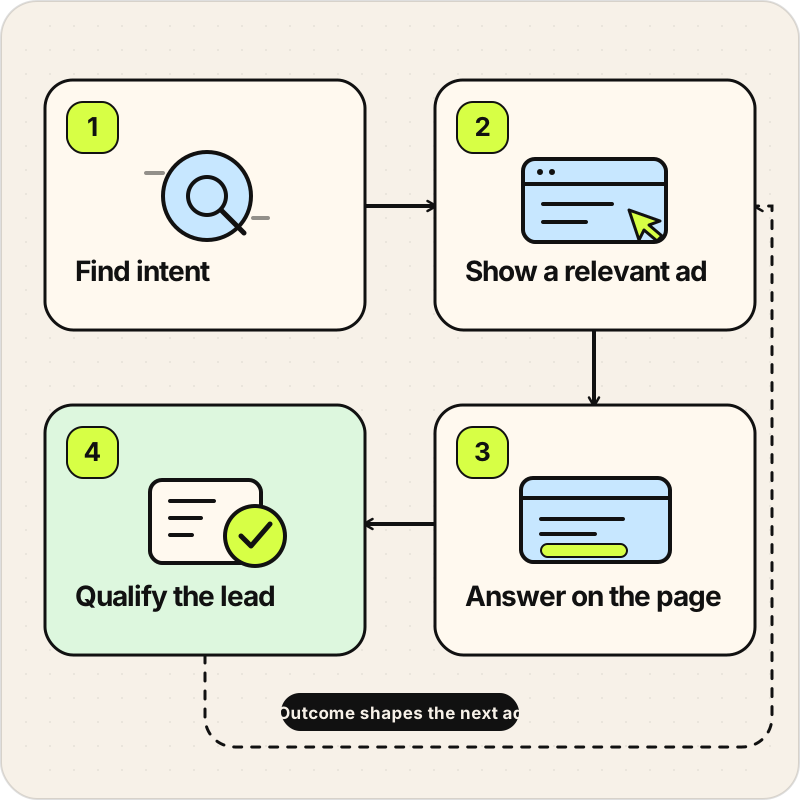
Direct answer
PPC services plan, launch and manage paid ad campaigns. They cover audience and search-term research, ads, landing pages, conversion tracking, budget control and reporting. A useful PPC agency measures qualified leads or sales, not clicks alone. Platform ad spend and the agency's management fee are separate costs.
Budget method
Work backwards from the value of a customer. This simple framework sets a ceiling for a test; your operating costs and required profit determine the actual target.
Multiply average sale value by gross margin. A ₹20,000 sale at 40% margin leaves ₹8,000 before marketing and overhead.
Multiply gross profit by your lead-to-sale close rate. At a 20% close rate, that example gives a rough ₹1,600 break-even cost per lead before other costs.
Reserve room for the management fee, fulfilment, taxes and profit. Test a budget that can produce enough qualified outcomes to make the next decision useful.
Capabilities
Explore the work behind pay per click advertising services: measurement, Search, social, commerce, video and B2B. A channel earns budget when it fits your buyer and produces useful outcomes.
Check GA4 events, platform conversions and CRM outcomes. Where appropriate, use enhanced conversions for leads to send qualified-lead or closed-sale signals back to Google Ads.
Teams whose reported conversions do not match real enquiries or sales.
Review search terms, campaign structure, budget allocation, creative, tracking and landing pages. Receive a prioritised account action plan.
Existing accounts that need an independent review before more spend.
Match each ad promise to a focused landing page with clear next steps, usable forms and measured page performance.
Campaigns getting relevant clicks but few qualified enquiries.
Search ads management for active buying intent: structured ad groups, useful ad copy, search-term reviews and negative keywords.
Services and products people already search for by name or problem.
Test Google's optional Search optimisation layer with brand, location and URL controls. Review generated assets and the search terms it adds before scaling.
Search accounts with reliable conversion signals and enough data to compare a test.
Build asset groups around useful products or offers, provide accurate conversion goals, and review asset, placement and search insights against business results.
Advertisers with good creative, clear offers and reliable conversion data.
Re-engage eligible visitors by intent, with consent-aware audiences, sensible frequency and exclusions for recent converters.
Longer consideration journeys and returning shoppers.
Develop and test offers, visuals and audience signals for Facebook and Instagram. Follow outcomes beyond platform-reported clicks.
Brands that can explain their offer visually or start a direct conversation.
Send prospects into a conversation, then measure the proportion who become qualified enquiries, appointments or orders.
Service businesses whose buyers ask questions before committing.
Improve Merchant Center feed quality, product grouping and campaign measurement so ecommerce PPC services account for margin and real sales.
Stores with a product catalogue and a measurable purchase journey.
Plan Sponsored Products and Brands around product economics, listing quality and advertising cost of sale.
Brands and sellers with active Amazon listings.
Use product education and video creative where a buyer needs to understand the offer before searching or enquiring.
Considered purchases and launches that need visual explanation.
Reach relevant companies and roles with an offer that earns a sales conversation. Connect leads to CRM stages instead of optimising only for form fills.
B2B services with a clear ideal-customer profile and sales follow-up.
Eligible text and Shopping ads from existing Search, Shopping and Performance Max campaigns may appear in AI Overviews in India for supported English queries. Eligibility is not a placement guarantee.
Advertisers already investing in eligible Google Ads campaigns.
Search and AI experiences
Google Ads can be eligible for placements with AI Overviews in India. Organic citations in Google, ChatGPT, Gemini or Perplexity require useful, accessible content and are never guaranteed by ad spend.
Eligible text and Shopping ads from Search, Shopping and Performance Max campaigns can appear with AI Overviews on supported English searches in India. Google excludes some sensitive categories; eligibility does not promise placement.
AI Max for Search campaigns can extend matching, customise text and select relevant URLs. Test the feature against qualified outcomes, with brand, URL and asset controls reviewed.
Clear service, pricing and FAQ content gives search and answer systems information to evaluate. For Google, the same core Search guidance applies to AI features; no special schema or keyword saturation can guarantee inclusion.
Platform references: Google Search: AI features guidance · Google Ads: Ads in AI Overviews · Google Ads: AI Max for Search · Google Ads: Enhanced conversions for leads
How we work
Five practical steps, from defining a qualified result to deciding which campaigns deserve more budget.
Agree on the product, location, target customer and what counts as a qualified lead or sale. Use unit economics to set a sensible cost-per-acquisition range.
Review the current account, tracking, search terms, landing pages and sales handoff. Fix measurement gaps before trusting automated bidding.
Choose channels by purchase intent and creative fit. Build campaigns and landing pages around specific offers, with exclusions and ownership documented.
Review real queries, creative and qualified outcomes. Use controlled tests where practical, and pause ideas that do not justify their spend.
Show platform spend, management fees, qualified leads, sales and what changed. Discuss uncertainty when the sales cycle is longer than the reporting window.
Unit economics
A useful cost-per-lead target depends on gross margin, sales close rate and the value of a customer. The figures below show the calculation steps, not a promise of campaign performance.
| Input | Example | Calculation | Why it matters |
|---|---|---|---|
| Sale value | ₹20,000 | Your average sale | Higher-value sales can support more acquisition cost. |
| Gross margin | 40% | ₹20,000 × 40% = ₹8,000 | This is contribution before advertising and overhead. |
| Lead close rate | 20% | ₹8,000 × 20% = ₹1,600 | Approximate break-even cost per lead before other costs. |
| Management fee | Separate | Add to acquisition costs | The fee changes your true break-even point. |
Illustrative arithmetic only. Real plans also account for repeat purchases, refunds, fulfilment, taxes and sales-cycle delay. Use your own numbers in the planner above.
Privacy & measurement
Reliable attribution starts with a clear conversion definition and responsible first-party data handling. Consent and platform requirements depend on where users are located and which tools you use.
Check the current DPDP Act and Rules requirements with qualified counsel for your processing and implementation timeline.
Document the purpose, data flow and choices shown to visitors.
Configure tags to honour user choices. Google's regional consent requirements vary; do not assume a single setup fits every audience.
Test what fires when a visitor accepts or declines.
Where eligible, pass CRM-verified qualified or converted leads back to Google Ads using supported enhanced-conversion methods.
Separate raw form fills from genuine opportunities.
Keep your business as the account owner, use role-based agency access and review who can export or change audience data.
Retain control of campaign history and permissions.
Where we run it
The same ad format serves different buying journeys. We define the action that matters in each category before choosing channels or bidding goals.
Appointment demand with careful handling of platform policies, location intent and lead quality.
Search, Shopping, Meta and marketplace campaigns judged against orders, contribution margin and repeat purchases.
Lead generation PPC that follows enquiries through qualification, meetings and pipeline.
Location and project campaigns measured on valid enquiries and site visits.
Course-specific offers, seasonal demand and counsellor follow-up tied to enrolment.
Area-specific ads and click-to-call or WhatsApp journeys measured on booked work.
Engagement models
These are RAASIS’s published starting plans. Ad spend is paid separately to the platform; applicable GST is separate. See the full rate card for campaign limits and exclusions.
₹14,999per month
One platform · ad spend up to ₹75,000/month
Best for: First-time advertisers and focused local campaigns
A clear starting scope for one channel. The client pays ad spend directly to the platform.
₹29,999per month
Two platforms · ad spend up to ₹3,00,000/month
Best for: Growing teams using two paid channels
Coordinate two channels around a shared qualified-lead or sales goal, with deeper measurement and more frequent review.
₹54,999per month
Up to four platforms · ad spend up to ₹10,00,000/month
Best for: Multi-channel and ecommerce advertisers
Bring Search, social and commerce together with stronger tracking, creative testing and revenue-oriented reporting.
₹94,999per month + 8% above ₹10L spend
Base fee plus 8% of monthly ad spend above ₹10,00,000
Best for: High-spend or multi-location accounts
A broader operating model with governance, a dedicated team and an explicit blended management rate.
A standalone PPC account audit is ₹22,000 one-time. Prices above exclude ad spend and applicable GST. Review the full PPC packages, spend ceilings and deliverables before choosing a plan.
Difference
| Decision | Ask before signing | What the RAASIS scope states |
|---|---|---|
| Media cost | Is ad spend included in the quoted fee? | Ad spend is separate and paid to the platform. |
| Ownership | Who controls the account and conversion history? | The client owns the account and grants access. |
| Measurement | What counts as a result? | Qualified leads or orders are defined before launch. |
| Scope | How many platforms and campaigns are covered? | Each plan has a published platform and spend scope. |
| Reporting | Will the report explain decisions? | The report includes outcomes and recommended next actions. |
Buyer intent
The right PPC management company should explain why a channel fits your demand. These examples connect buyer intent to a useful first decision.
Questions
Direct answers to the questions buyers ask about cost, timing, ownership, measurement and AI search.
PPC services can include campaign planning, keyword and audience research, ad creative, landing-page recommendations, conversion tracking, search-term reviews, budget management and reporting. The exact channels and production work should be stated in the proposal.
RAASIS publishes monthly management plans from ₹14,999 to ₹94,999, with an additional 8% on monthly ad spend above ₹10,00,000 in the Enterprise tier. A standalone account audit is ₹22,000. Ad spend and applicable GST are separate. Compare scope and spend ceilings before comparing fees.
Start from the sale value, gross margin, lead-to-sale close rate and number of useful leads you need. This produces a break-even acquisition cost that can inform a test budget. Auction prices and conversion rates vary, so no universal minimum guarantees a result.
Ads can begin receiving eligible traffic after approval, but the time needed to judge profitability depends on your conversion volume and sales cycle. Review tracking and search terms early; judge qualified-lead or sales performance only after enough outcomes have been observed.
Search campaigns focus on relevant searches and provide direct keyword and ad-group controls. Performance Max can serve across several Google channels and relies heavily on assets, goals and conversion data. The better starting point depends on the offer and measurement quality.
Treat AI Max as a controlled test within an existing Search campaign, not a separate ad network. Review search-term matching, generated text, final URL expansion and brand or URL controls. Keep it only when qualified outcomes improve.
Yes, Google says eligible text and Shopping ads from existing Search, Shopping and Performance Max campaigns can appear with AI Overviews in India on supported English searches. Sensitive categories can be excluded, and eligibility does not guarantee an impression.
Buying Google Ads does not buy an organic citation in another AI product. For those experiences, publish accurate, crawlable pages that answer buyer questions and monitor the referral or citation data available to you. Advertising availability varies by product and time.
Define a qualified lead with the sales team, connect form or call records to CRM stages, and compare ad spend with qualified opportunities and closed sales. Where supported and appropriate, feed those offline outcomes back into the ad platform.
Your business should own its ad accounts and payment method. RAASIS works through granted access, so you retain campaign history, creative, conversion data and control of permissions if the engagement ends.
Yes. PPC can test offers and reach eligible audiences quickly while SEO builds useful, crawlable pages that may earn organic visibility over time. Search-term and conversion insights can inform both, but neither channel guarantees a ranking or sale.
Talk through your PPC brief
Tell us what you sell, which channels you use and what a qualified lead means to your team. We can recommend a plan or explain the separate ₹22,000 account-audit scope. Please do not send ad-account credentials through this form.
Explore further